This week I attended a lecture on the Basic Biology of COVID-19 which was part of the Stanford CME Courses. The lecture was filmed on 3/27/20 and published on 4/1/20. I felt it was important to use this unprecedented time to learn more about COVID-19 and other topics that interest me in nutrition, medicine, and health. I wanted to share what I learned with others and inspire them to partake in this journey as well! Thank you to Stanford Center for Continuing Medical Education for providing open resources and videos!
What is COVID-19?
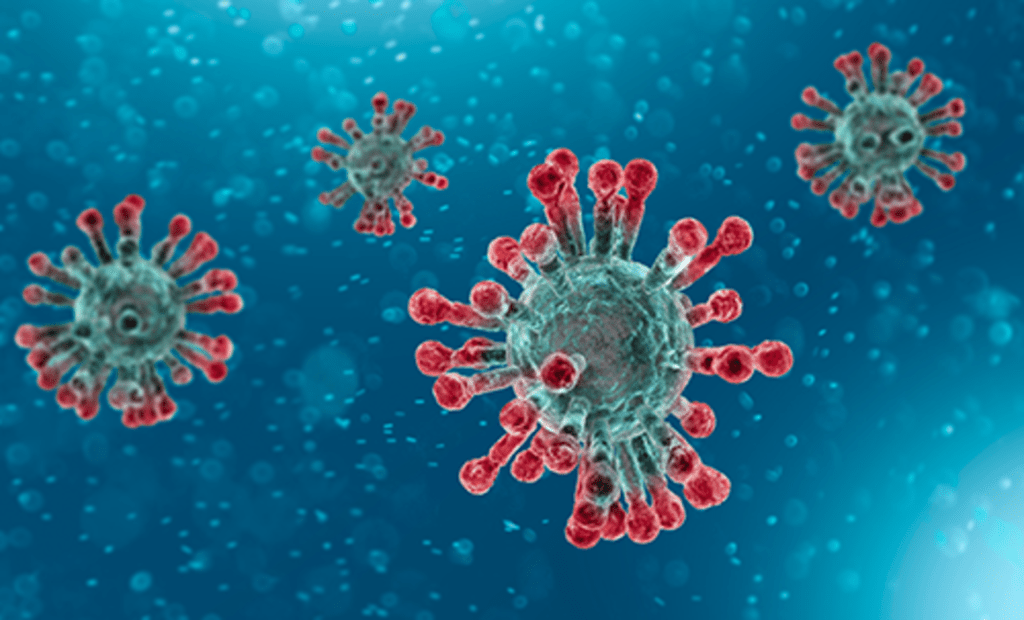
The scientific name for COVID-19 is SARS-CoV-2. SARS-CoV-2 is a member of the coronavirus family. Coronaviruses are positive strand RNA viruses that usually possess large genomes (over 27,000 base pairs). The coronavirus family of viruses is well known to medical professionals because they are the cause for many common types of diseases in humans. Of the coronaviruses, the ones that affect humans the greatest tend to fall in the alpha and beta subfamilies. Previously known coronaviruses account for 10-30% of common cold cases. Coronaviruses tend to easily transfer between species. In 2012, the first MERS-CoV outbreak hopped from camels to humans. In 2003, the SARS-CoV went from bats to humans. Similarly, it is suspected SARS-CoV-2 transferred from bats to humans via an intermediary species. SARS-CoV-2 is 80-90% identical at sequence level to SARS-CoV, so research on SARS-CoV can be applied to that of SARS-CoV-2.
What is unusual about SARS-CoV-2?
Coronaviruses have genomes composed of RNA. However, SARS-CoV-2 demonstrates an unusual stability for RNA viruses that usually possess extremely low mutation rates. A Pubmed publication showed the CoV OC43 strain isolates of coronavirus, which cause the common cold, from the 1960s and 2001 had only 2 amino acid differences (Pubmed 15280490). SARS-CoV-2 on the other hand has shown stability and mutation.
SARS-CoV-2 Lifecycle
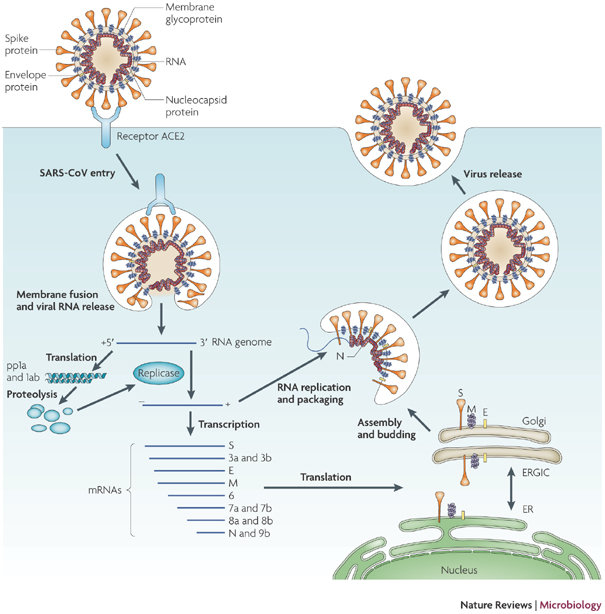
SARS-CoV-2 first needs to bind to the cell to gain entry. To do this, the spike proteins on the outside of the virus (known as S proteins), bind to ACE2 (Angiotensin- converting receptor 2) protein receptor on the cell surface. After binding, the spike proteins need to be activated. This is achieved by a cleavage event done by protease. TMPRSS protease reside on the cell membrane and Cathepsin L protease reside in endosomes. These two types of protease activate spike proteins and facilitate membrane fusion. TMPRSS2 and Cathepsin L cleave the spiked protein allowing it to invert the membrane and allow viral entry. Lung epithelial cells in particular have a high level of expression of ACE2 receptors resulting in the virus’ attack on the lungs. After the protease activates the spike protein, a single positive strand of RNA is released into the cytosol of the cell. The positive single-strand RNA (ssRNA) is now ready for translation by host ribosomes. Host ribosomes translate the positive ssRNA into a large single nonstructural polyprotein. Following this, the polyprotein must be cleaved into smaller pieces. This second cleavage event is done by two viral proteases embedded within the polyprotein. The viral proteases cleave themselves out and process the polyprotein into smaller pieces. The new smaller pieces combine together to create a replicase complex that includes RNA dependent RNA polymerase. Replicase can now produce full length copies of the positive and negative strands of the RNA genome.
The positive strands are packaged into new variant particles while the negative strands are used to transcribe subgenomic mRNA. These encode for different structural components: spike protein and envelope protein. This enables the production of more viruses. As new proteins meet new positive strand genome copies, the virus replicates and is able to bud out into the exocytic vesicle and fuse with the membrane. The virus particle can now be released.
SARS-CoV-2 Environmental Sensitivity
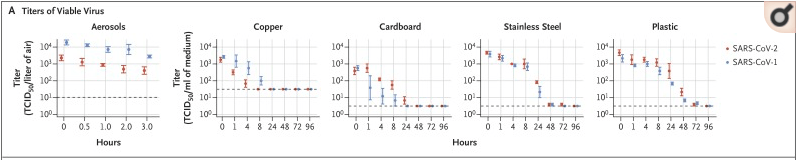
Because coronaviruses are envelope viruses (take a piece of membrane with them), it is fairly easy to disrupt the plasma membrane around the virus and kill it. Coronaviruses can be killed with detergents and alcohol. The proteins of the virus can be directly killed with bleach. Overall, common cleaning agents usually will do a complete job of killing the virus. Coronaviruses have limited viability on surfaces and with different temperatures. At higher temperatures, the virus tends to demonstrate a lower survival rate. SARS-CoV-2 is also susceptible to UV damage. UV will damage the genetic material of the virus. Studies show coronavirus is 2-3 times more sensitive than influenza to UV radiation. Additionally, SARS-CoV-2 demonstrated a 10-fold decrease in survival on surfaces after being exposed to 2-3 hours of direct sunlight. A New England Journal and Pubmed publication have demonstrated the survival rate of SARS-CoV-2 depends on the surface it has occupied. Virus dried on copper was inactivated by one log in just one hour. On cardboard surfaces, within 4-8 hours, one log of the virus was killed off. On stainless steel and plastic surfaces, 90% of the virus was inactivated after around 12 hours (Pubmed 32182409). It is hypothesized that on absorbent materials, the survival rates of the virus should be lower than that of cardboard. The virus also should be more effectively trapped on porous material such as paper towels.
 Journey To Cure
Hey Ishwari, great post! It’s quite informative with a lot of statistics. You’ve explained about the SARS-CoV-2 in a nutshell. If you could add a bit of information about the isolation of the virus, it would be great!
LikeLike